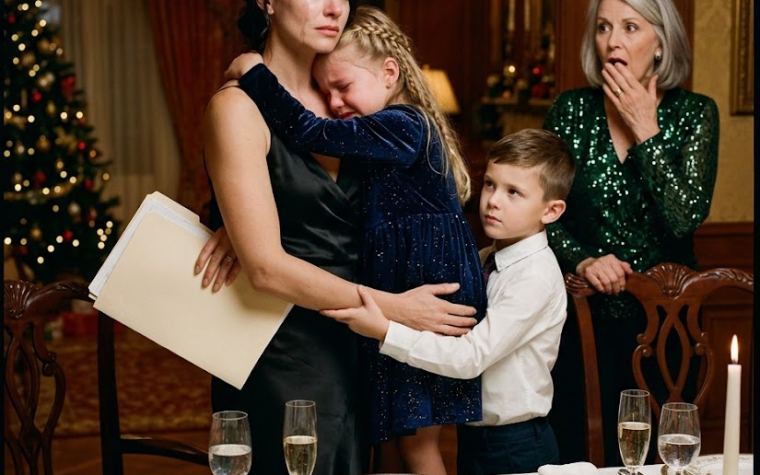
That strategy failed when the financial timeline showed that the Sterling defaults existed before the attack.
I had not invented their misconduct.
I had merely stopped protecting them from it.
The criminal case took months.
By then, Chloe had learned to walk short distances with assistance.
The pregnancy remained difficult, but every week gave the baby a better chance.
Liam attempted to contact her through intermediaries, first apologizing, then blaming Eleanor, then warning that testimony would destroy the child’s inheritance.
Chloe listened to one message and asked that the rest be preserved for her attorney.
“He still thinks money is the only future a child can have,” she said.
At thirty-four weeks, complications forced an early delivery.
I stood outside another operating room, remembering the night Dr.
Mitchell had told me to prepare to lose both of them.
This time, when he emerged, he was smiling.
Chloe had survived the surgery.
Her baby was small and needed specialized care, but she was breathing.
When I was finally allowed into the room, Chloe held her daughter against her chest with both arms.
The same arms that had tried to shield the baby beneath the bus shelter were now strong enough to hold her safely.
The trial ended with Liam and Eleanor convicted on the evidence of what they had done.
Their financial crimes were handled separately, producing additional penalties and permanently removing them from control of the companies.
The viable parts of the Sterling businesses were reorganized under new management.
Properties were sold to satisfy debt, but employee pensions and wages were protected wherever possible.
The mansion was sold.
The silver that had supposedly justified Chloe’s punishment was cataloged with the rest of the estate’s possessions and disappeared into an auction.
Neither Liam nor Eleanor was present to see it go.
Months later, Chloe and the baby came home from rehabilitation to a modest house with wide doorways, quiet rooms, and no one inspecting the silverware.
She still struggled with headaches and gaps in memory.
Some mornings her right hand shook when she tried to lift a cup.
Recovery had not transformed the assault into something inspirational.
It had left damage that required patience, treatment, and grief.
But the damage no longer defined the boundaries of her life.
One evening, while rain tapped gently against the windows, Chloe asked me about the gasoline.
I told her everything.
She listened without interrupting.
“Were you really going to light it?” she asked.
“For a moment, yes.”
“What stopped you?”
“The hospital alert.
You moved your hand.”
She looked down at her sleeping daughter.
“So I saved you too.”
I nodded.
“Yes, sweetheart.
You did.”
She reached across the table and placed her hand over mine.
The Sterlings had believed power meant hurting someone and deciding what the truth would be afterward.
They had believed wealth could turn witnesses silent, injuries invisible, and consequences negotiable.
They were wrong.
The real power had been Chloe surviving long enough to speak.
It had been a doctor documenting what he saw, police officers listening at a freezing bus stop, and a folder filled with signatures the Sterlings had assumed would never matter.
I had nearly answered violence with fire.
Instead, I opened the folder.
And once the truth entered the room, their empire collapsed under the weight of everything they had done to build it.