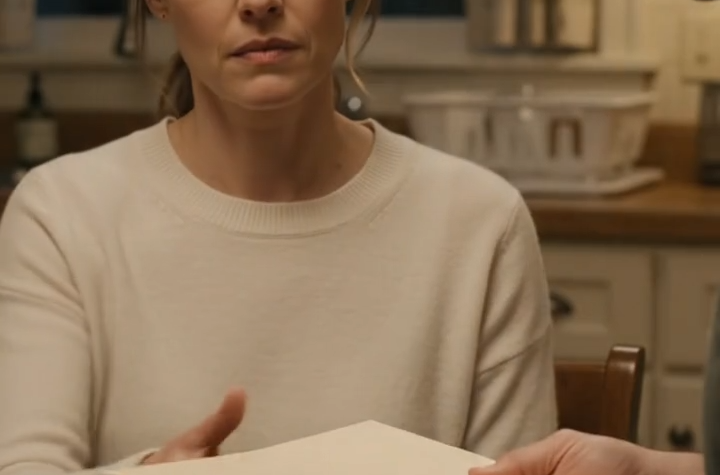
Adrian’s hand stopped above the kitchen counter.
For a moment, neither of us moved.
I was still standing just inside the apartment with my purse hanging from one shoulder, my feet aching from a double shift, my brain trying to make sense of a room that looked familiar and completely different at the same time.
The trash was gone.
The counters had been wiped until the old laminate actually shone beneath the weak kitchen light.
The cabinet door that had hung crooked for months was straight.
A pot simmered gently on the stove.
And beside the cabinet lay a few small things Adrian had collected while working: the loose screw that had been failing to hold the hinge, a bent little piece of metal, and one of the cheap tools I kept in the junk drawer but could never figure out how to use properly.
Nothing valuable.
Nothing mysterious.
Just proof that somebody had noticed what was broken and had bothered to fix it.
Adrian looked at me as if he expected anger.
“I hope I didn’t overstep,” he repeated.
His voice was different from the night before.
Still soft, but tense now.
I set my purse down slowly.
“You fixed the cabinet?”
He glanced toward it.
“It was mostly the hinge.
The screw wasn’t catching anymore.
I moved it a little and tightened it into better wood.”
He said it like anyone should have known how to do that.
I opened the cabinet door.
It swung smoothly.
I closed it.
For the first time in months, it stayed closed.
I actually laughed.
Not because it was funny.
Because I had gotten so used to pushing that door shut every morning that seeing it behave normally felt absurd.
Adrian’s shoulders relaxed by an inch.
“And the rest of this?” I asked.
He looked around the kitchen.
“I woke up early.
I didn’t know when you’d be back.”
“So you cleaned my apartment?”
“Some of it.”
“And cooked?”
He nodded toward the stove.
“Nothing special.
Just what was here.
I didn’t want to waste anything.”
I stared at him.
The man I had found under an old blanket near a bus stop had spent his day cleaning my kitchen, carrying out my trash, repairing a cabinet and turning whatever he could find in my cupboards into dinner.
He had done it while wearing a brace on a leg that obviously hurt him.
“Why?” I asked.
The question came out more sharply than I intended.
His face closed immediately.
That reaction told me something before he answered.
He was used to people questioning his motives.
Used to every action being inspected for danger.
Used to having to prove he deserved whatever small kindness had been offered.
“You let me sleep here,” he said.
“Your boy treated me like a person.
I wanted to leave the place better than I found it.”
I looked at the clean counter again.
Then at the repaired cabinet.