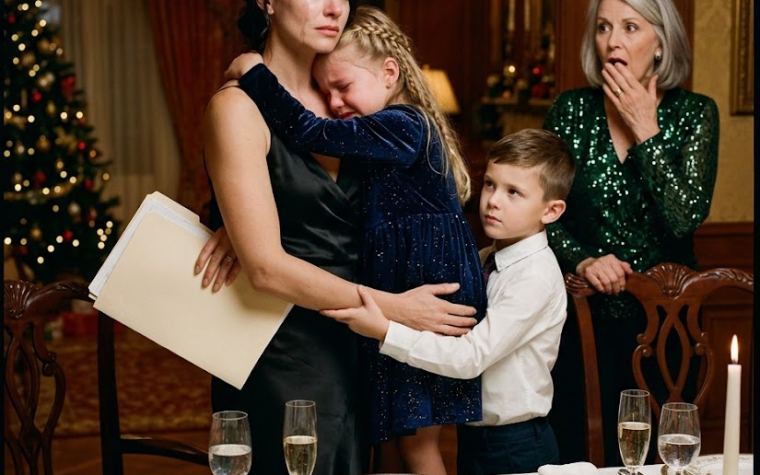
I slid one finger beneath the envelope flap.
Spencer went pale.
The elevator chimed outside the condo, followed by the heavy rhythm of approaching footsteps, but nobody at the table moved.
For the first time that evening, Constance’s expression lost its polished contempt.
Her eyes fixed on the envelope in my hand.
“Put that down,” Spencer said.
His voice had changed.
There was no velvet left in it.
I looked at Madeline.
She was still on the marble floor beside me, one hand pressed to her cheek.
But she was staring at the envelope too.
“You’ve seen this before,” I said quietly.
Her throat moved.
“Something like it.”
Spencer stepped forward.
The knock on the door stopped him.
“Police.”
I kept the envelope in my hand while Spencer’s face rearranged itself into the expression men like him reserved for witnesses: reasonable, wounded, almost amused.
He opened the door as though he were welcoming neighbors to a cocktail party.
Within minutes, that performance collapsed.
Madeline’s swelling face, the overturned chair, my eyewitness account, the recording, and Constance’s own indignant insistence that Madeline had needed “correction” gave the officers more than enough reason to separate everyone immediately.
Spencer tried charm first.
Then outrage.
Then connections.
“My family knows people downtown,” he snapped while an officer instructed him to turn around.
The officer did not appear impressed.
When the cuffs closed around Spencer’s wrists, he looked directly at Madeline.
The look was more frightening than shouting would have been.
It promised punishment later.
I stepped between them.
He smiled at me instead.
“You think you understand this family?”
“I understand patterns,” I said.
His smile vanished.
Constance refused to leave with him.
She demanded an attorney, accused me of manipulating Madeline, and announced repeatedly that the entire incident had been “misinterpreted.”
But she made one mistake.
She kept looking at the envelope.
So did Spencer.
That told me the paper mattered.
After the officers took him away, Madeline finally let me help her onto the sofa.
The condo fell strangely quiet.
Half-eaten short ribs sat under cooling sauce.
William’s birthday candle was still burning beside the photograph Madeline had placed near the window.
I extinguished it before we left.
At the hospital, Madeline barely spoke.
She answered medical questions in clipped phrases and apologized three separate times for “making everything complicated.”
Each apology made my stomach tighten.
I had spent 32 years telling clients that coercive control alters a person’s sense of what is normal.
I knew why intelligent people stayed.
I knew why victims minimized injuries, protected reputations, concealed finances, and feared consequences outsiders could not see.
Knowing the theory did not make hearing my daughter apologize for being assaulted any easier.
When we were finally alone, I placed the envelope on the small plastic table beside her hospital bed.
“Tell me what you know.”
Madeline stared at it for several seconds.
“About six months ago, Spencer asked me to sign some financial papers.”