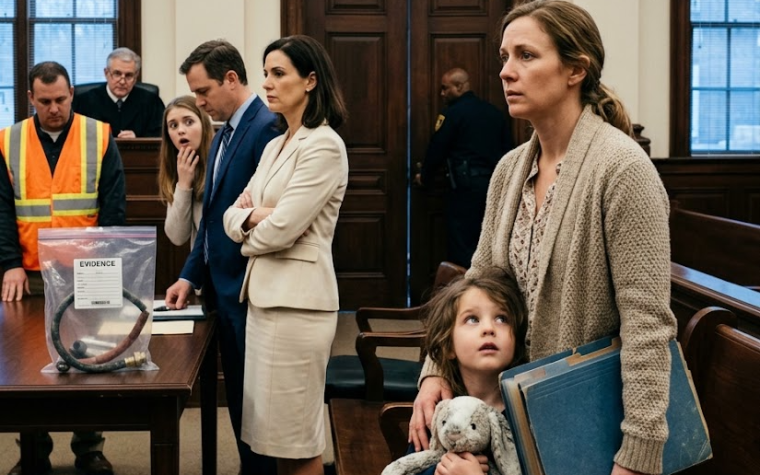
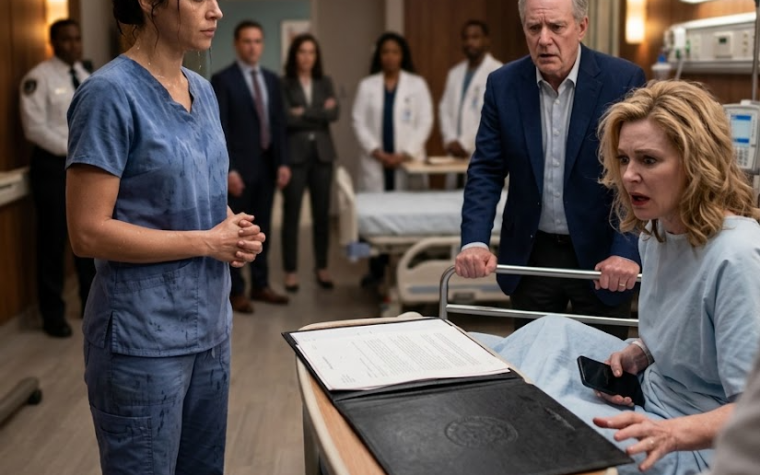
She did not tell him he was definitely connected to a future child.
At that point, I wasn’t pregnant.
She told him only that her daughter was married to a man who controlled information, that there was a medical secret Brooke might someday need, and that if Adrian ever received proof linking him to the case, she wanted him to make sure I could access the records safely.
Adrian had promised.
My mother left funds with an independent attorney to pay for legal help if the marriage collapsed under specific circumstances.
She also placed copies of her notes, correspondence, and the clinic reference information in sealed storage.
That was why the envelope could not be released while I remained married and unaware.
She had not tried to decide my life for me.
She had created an exit I could choose to use.
I cried when I understood that.
Not because of Cole.
Because four years after my mother died, she was still protecting my ability to make my own decision.
The legal battle did not disappear overnight.
Cole did exactly what wealthy, frightened men with excellent lawyers often do in stories like ours: he attacked every weakness he could find.
He argued that he had acted as an intended father throughout most of the fertility process.
He argued that I had known donor conception was possible.
He argued that Adrian’s money was influencing me.
He even claimed my mother’s records had been assembled to prejudice him.
Then discovery began.
Emails surfaced.
Clinic correspondence surfaced.
Bank records surfaced.
So did messages between Cole and Brielle from months before our divorce.
One message mattered more than the others.
Cole had written that once the triplets were born, he could use his money and my lack of resources to secure the parenting arrangement he wanted.
He described me as “too dependent to fight for long.”
I read the sentence twice.
Then I handed the phone back to my attorney.
That message did not decide the entire case by itself.
Neither did the fertility record.
Neither did Adrian’s connection.
Together, however, they changed the picture.
Cole was no longer a betrayed husband fighting for children he believed were biologically his.
He was a man who had hidden donor conception, concealed irregular parentage paperwork, abandoned his pregnant wife with almost no accessible money, and then attempted to use the financial instability he created as leverage against her.
Judges tend to notice patterns.
So do lawyers.
So do hospital social workers.
The temporary orders went badly for Cole.
He did not receive the immediate control he demanded.
Any contact with the babies while questions of legal parentage were reviewed had to follow strict court-approved conditions.
The court also ordered him to stop interfering with accounts and records relevant to my medical care and the children’s needs.
My mother’s emergency fund gave me enough stability to rent a small furnished apartment close to the hospital.
Adrian offered far more.
I refused far more.
That surprised him.
“You don’t have to prove anything by struggling,” he told me one afternoon in the neonatal unit.
“I’m not proving anything,” I said.
“I’m deciding what belongs to me.”
He nodded.
That became the basis of our relationship.
Not romance.
Not rescue.
Boundaries.
He was biologically connected to the triplets, but biology did not suddenly grant him ownership either.
He understood that before anyone had to explain it.
He completed every test the court and physicians requested.