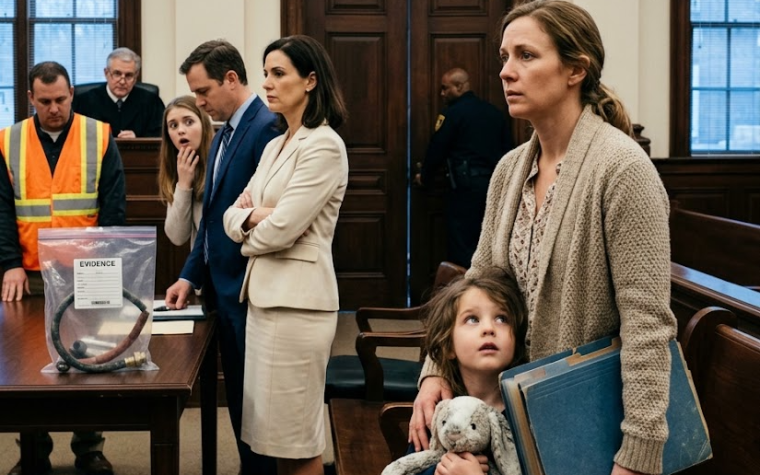
The findings did not magically answer every question, but they were enough to make Michael’s confidence evaporate.
He stopped saying, “We’ll handle the estate.”
He started saying, “There must have been a misunderstanding.”
Sarah stopped calling me an extra mouth.
She started leaving messages about how “families make mistakes.”
I saved every one.
Rafael’s part of the truth came more slowly.
He did not ask me to call him Dad.
He did not pretend forty-two lost years could be repaired by a photograph and a reunion in a bank conference room.
He showed me what he had kept.
A copy of a letter he had written to my mother that came back unopened.
A photograph of the two of them taken before I was born.
Notes about attempts to contact her after he was told she wanted nothing more to do with him.
Later, after my mother’s death, he had searched again, but by then information had shifted, addresses had changed, and people who could have connected us gave him nothing useful.
“I believed the lie longer than I should have,” he told me.
That sentence mattered because he did not use it to erase his own regret.
Grandma’s letter filled in pieces neither of us had possessed.
She admitted she had learned the full extent of the deception too late.
At first she had believed the same family explanations I had.
Later she found inconsistencies.
Then altered records.
Then correspondence that had never reached its destination.
By the time she understood how much had been hidden, fear had become habit.
She did one thing differently.
She began preserving everything.
The money gave her the ability to protect the evidence, but it was never the point of the evidence.
I was.
One paragraph near the end of her letter broke me more completely than the bank statement had.
“Daniela, they may tell you this is about inheritance.
It is not.
Money can be counted.
Years cannot.
I cannot give you back your mother or the father you were denied.
I can only leave you enough truth that nobody gets to decide your life for you again.”
I read that paragraph three times.
Rafael cried without hiding it.
Months passed before the estate was fully settled, but Grandma’s will remained in force.
The house stayed mine.
The accounts she had designated for me transferred under the legal process she had arranged.
Her records remained with my counsel rather than disappearing into a family drawer.
Michael and Sarah did not receive the control they had expected when they talked about returning after the funeral “with a lawyer.”
There were consequences beyond inheritance.
Questions surrounding the altered papers and disputed transfers had to be answered through the proper legal channels.
Some claims they tried to make against the estate collapsed when confronted with Grandma’s preserved originals and independent records.
Their certainty became caution.
Their threats became carefully worded statements delivered through attorneys.
What mattered most to me was simpler.
They could no longer rewrite Grandma while I stood silently in the room.
When Sarah said Grandma had been confused, I had medical documentation.
When Michael said she had promised him control, I had the will.
When either of them suggested I had manipulated a lonely old woman, I had years of bank instructions, attorney notes, witness signatures, and Grandma’s own careful handwriting.
And when they treated Rafael like a stranger who had appeared because of money, I had a photograph taken decades before any of us knew there would be millions to fight over.
The first thing I changed was Grandma’s grave marker.
Not because she would have cared about marble.
She probably would have complained about the price.
I changed it because the cheap funeral had been their final attempt to define her as a woman with nothing.